Professional window cleaners do not rely on one universal cleaning liquid. At Cardiff Window Cleaner Ltd, our primary method for exterior windows is purified water delivered through a water-fed pole, while applicators and squeegees are used for internal windows, smaller areas and detailed work.
The important difference is the cleaning system. In a traditional clean, a solution is applied and removed with a squeegee. In pure-water cleaning, purified water, brush agitation and a thorough rinse allow the glass to dry naturally.
What We Actually Use at Cardiff Window Cleaner Ltd
For routine window cleaning, these are the two methods we use according to where the glass is and how the job needs to be approached.
| Method | What we use | Typical application | How the finish is produced |
| Pure-water water-fed pole | Purified water, telescopic pole and brush | Our primary method for exterior windows, including higher glass that can be reached safely from the ground | The glass and frames are brushed, rinsed and left to dry naturally |
| Traditional hand cleaning | Suitable cleaning solution, applicator, squeegee and detailing cloth | Internal windows, smaller areas and detailed work | The cleaning solution is physically removed with the squeegee |
This is why asking what window cleaners “put in the water” only tells part of the story. With one professional method a cleaning solution is used; with another, properly purified water forms the cleaning and rinsing system.
What Do Window Cleaners Use to Clean Windows: How Pure-Water Cleaning Works
Our primary exterior system uses water that has been filtered and de-ionised before being delivered through a telescopic water-fed pole.
Deionisation and reverse osmosis are recognised methods of producing purified water for professional window cleaning. The purpose is to remove dissolved minerals and impurities that ordinary tap water can leave behind as it dries.
The Brush Does the Physical Cleaning
Pure-water cleaning is not simply a case of spraying purified water onto dirty glass.
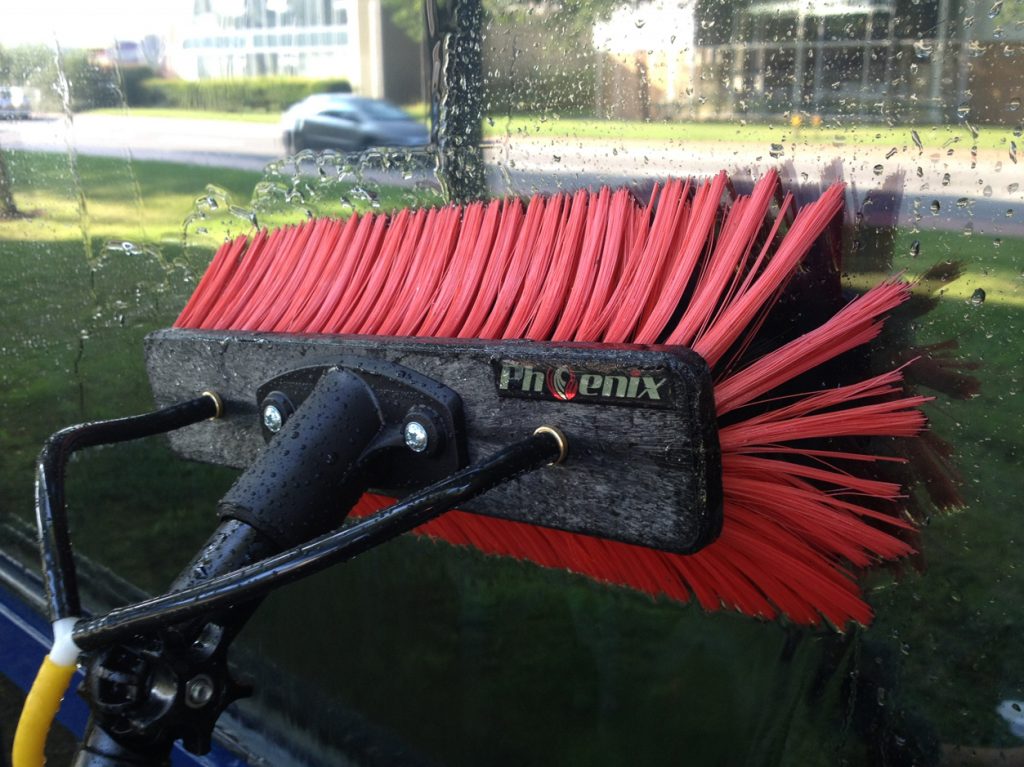
A brush at the end of the pole agitates the glass and frames to loosen normal dirt. A continued flow of purified water then carries that contamination away and provides the final rinse.
The system therefore combines:
- purified water;
- brush agitation;
- thorough rinsing.
One of the less obvious professional lessons is that a better clean does not necessarily mean adding more chemicals. Professional pure-water systems can clean suitable exterior glass without detergent.
Why Do Window Cleaners Leave the Windows Wet?
With traditional cleaning, a squeegee removes the cleaning solution from the pane.
Pure-water cleaning works differently. Because dissolved minerals have been removed from the final rinse water, the glass can be left wet and allowed to dry naturally rather than being polished or squeegeed by hand. Professional pure-water systems are specifically designed around this brush, rinse and natural-dry process.
So if windows are still wet when a water-fed pole clean is finished, that does not mean the cleaner has forgotten to dry them.
Water-fed poles also change how higher windows can be accessed. Because the poles extend from ground level, many upper-floor windows can be cleaned without placing an operative directly at height, making the process safer and more efficient where the building allows it.
What Do Window Cleaners Use to Clean Windows: What Traditional Cleaning Uses
Traditional professional window cleaning uses a small group of tools as one system:
- a washer or applicator to work cleaning solution across the glass;
- a rubber-bladed squeegee to remove the dirty solution;
- a clean cloth for limited detailing around edges and corners.
Professional traditional-window-cleaning ranges are built around the same washer, squeegee and microfibre combination.
There is no universal professional “bucket recipe”. Different cleaning products have their own dilution instructions, and the solution is only one part of the result. Tool condition and technique also affect what is left behind on the glass.
At Cardiff Window Cleaner Ltd, this traditional approach is particularly useful for internal windows, commercial interiors and other areas where closer control and detailed hand cleaning are required.
What About Paint, Stickers, Bird Mess and Other Stubborn Marks?
Routine dirt and material stuck to the glass are not necessarily the same cleaning problem.
Professional tool ranges include specialist equipment such as glass scrapers for certain stuck-on deposits, including stickers and paint splashes.
But this is also where blindly copying a “professional tool” can go wrong.
The type of glass matters too. Coated or specialist glass can have its own cleaning restrictions, so a tool that is suitable for standard glass may not be appropriate for every surface. Scrapers and abrasive materials should therefore never be treated as a default solution without first considering the glass being cleaned.
So the professional decision is not simply:
Which stronger tool will remove this mark?
It is:
What is on the glass, what type of glass is it, and which method can remove the contamination without damaging the surface?
Sometimes knowing what not to use is as important as the equipment in the van.
Reaching the Window and Cleaning the Window Are Different Decisions
This distinction becomes particularly important on commercial and high-rise buildings.
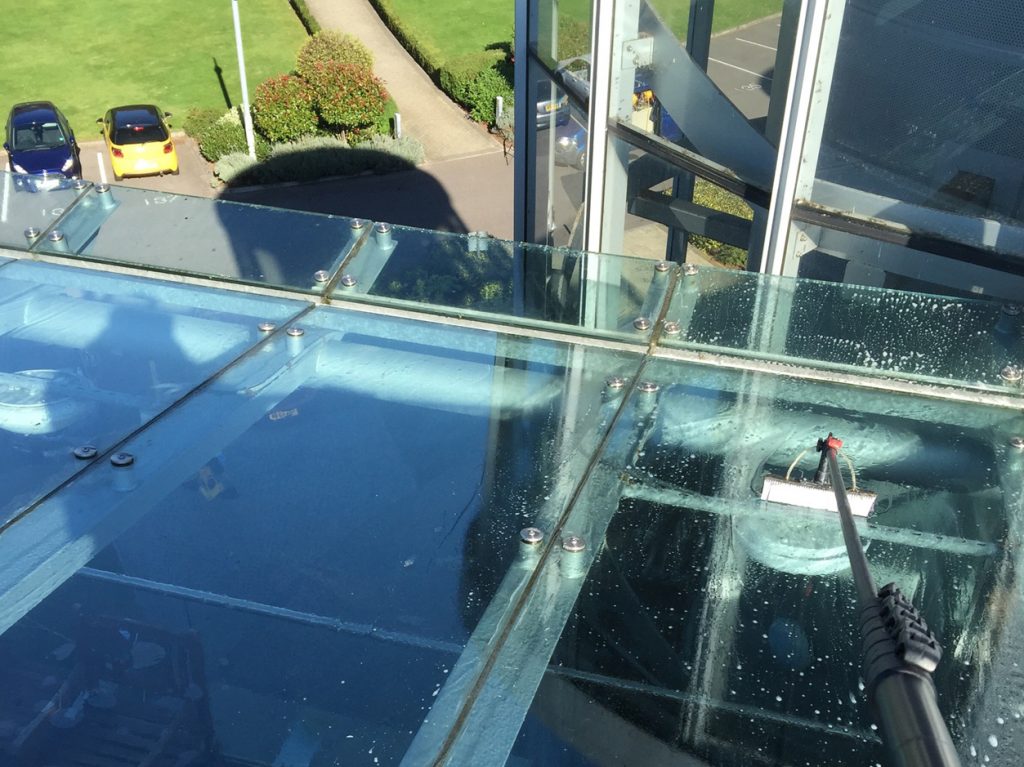
A water-fed pole can provide both reach and the cleaning system itself: the pole takes purified water and a brush to glass that can be accessed from the ground.
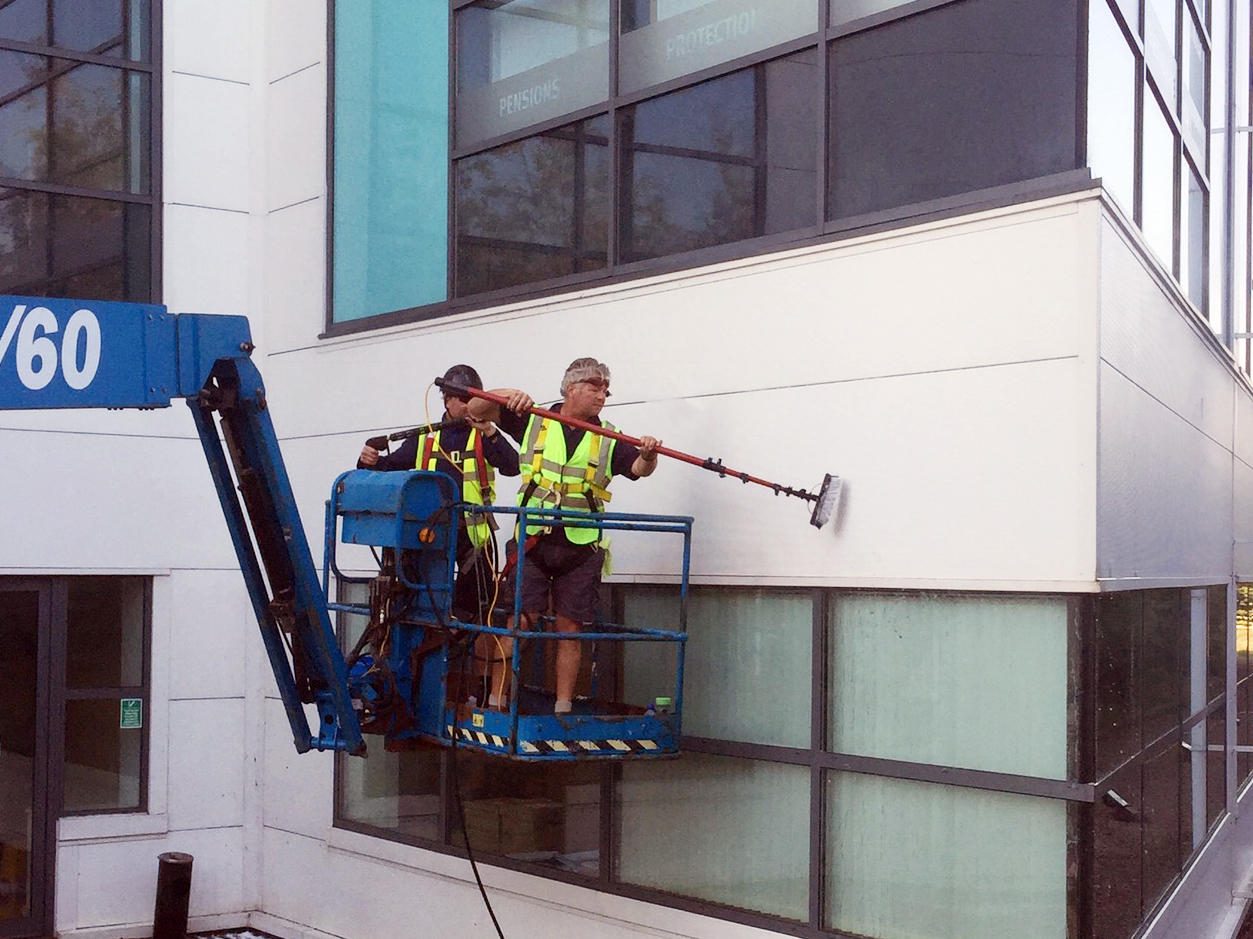
Rope access, a cradle or a mobile elevated work platform solve a different problem. Their primary job is to position the cleaner safely where the glass can be reached.
Once the operative reaches the window, there is still a separate decision about the appropriate way to clean that glass.
That is why high-rise buildings do not necessarily require some special “high-rise window cleaning liquid”. Access and cleaning method are related decisions, but they are not the same decision.
You can see more about those access requirements in our high-rise window cleaning and commercial window cleaning services.
Can You Use the Same Methods at Home?
For an accessible window at home, the traditional principle is straightforward: use a suitable cleaning solution, an applicator or washer, and a good squeegee to remove the dirty solution from the glass.
What should not be copied casually is the access side of professional window cleaning. Work at height should be avoided where reasonably practicable, including by using methods such as telescopic water-fed poles or cleaning safely from inside.
A professional pure-water clean also depends on properly purified water, the right equipment and thorough brushing and rinsing. Putting ordinary tap water through a long pole does not create the same system.
And if a window has a specialist coating or unusual contamination, check the glass manufacturer’s cleaning requirements before using scrapers, abrasive tools or stronger chemicals.
The professional difference is therefore not one secret ingredient. It is choosing the water, tools and method that suit the particular window and the job.
Cardiff Window Cleaner Ltd has provided professional exterior cleaning since 2015, with more than 70 years of combined team experience. From routine window cleaning to commercial and high-rise work, we choose the cleaning method and access approach to suit the glass, building and level of contamination rather than assuming every job needs the same equipment. Get in touch today!