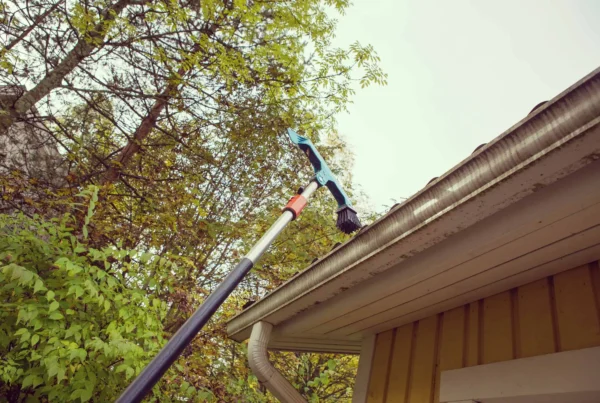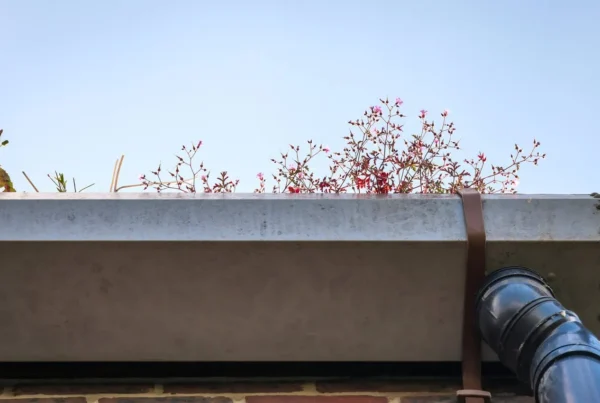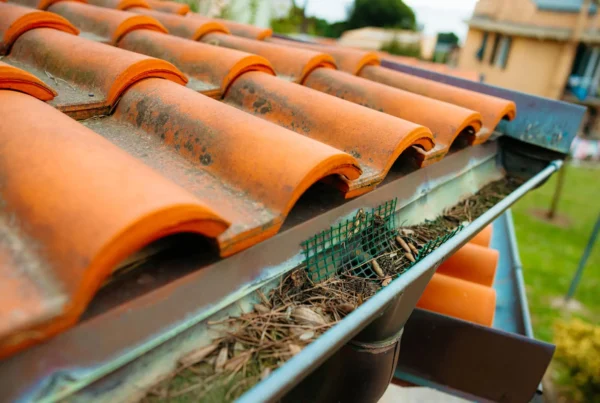

A leaking roof is not always fixed by repairing the roof covering. Water can enter because tiles, flashing or another roofing detail has failed, but overflowing gutters and restricted roof drainage can also send water where it should not go.
If water is actively entering, protect the area inside first. Then identify the likely water path before choosing the fix: clear a blockage where drainage is the problem; repair damaged guttering where the rainwater system has failed; use a roofer where tiles, flashing, membranes or other roofing components are defective.
How to Fix a Leaking Roof: What to Do First if Water Is Coming In
If water is actively dripping, focus on limiting damage rather than trying to reach the roof.
Move furniture and belongings away from the affected area and contain dripping water where this can be done safely. Take photographs of the damp and note when the leak appears, as the timing can help with diagnosis later.
Keep clear of ceilings that are bulging or sagging, and treat water around electrical fittings as an urgent safety issue.
Avoid climbing onto a wet or unfamiliar roof to look for the source. Work at height carries significant risk, and safe guidance prioritises doing as much as possible from ground level where practical.
Is It the Roof or the Rainwater System?
Gutters and downpipes are part of the building’s roof-drainage system: they collect water from the roof and carry it away. If that route becomes blocked, damaged or unable to cope with the flow, water can end up against parts of the building that should remain dry.
Use the pattern of the problem as a clue rather than assuming every damp patch means the tiles have failed.
| What you notice | What it may indicate | Most useful next step |
| Gutter overflowing during ordinary rain | Blockage or restricted outlet/downpipe | Check and clear the rainwater path |
| Gutter appears clear but overflows mainly during heavy rain | Poor fall/alignment or insufficient drainage capacity | Have the rainwater system inspected |
| Damp or staining below the eaves/gutter line | Gutter/downpipe or roof-edge problem | Check both before assuming roof failure |
| Staining around a chimney, roof vent or roof junction | Flashing or roof-detail problem | Roofer |
| Visible slipped, cracked or missing tile/slate | Roof-covering defect | Roofer |
| Ceiling stain with no obvious defect directly above it | Water may be travelling before becoming visible | Trace the source rather than simply repairing above the stain |
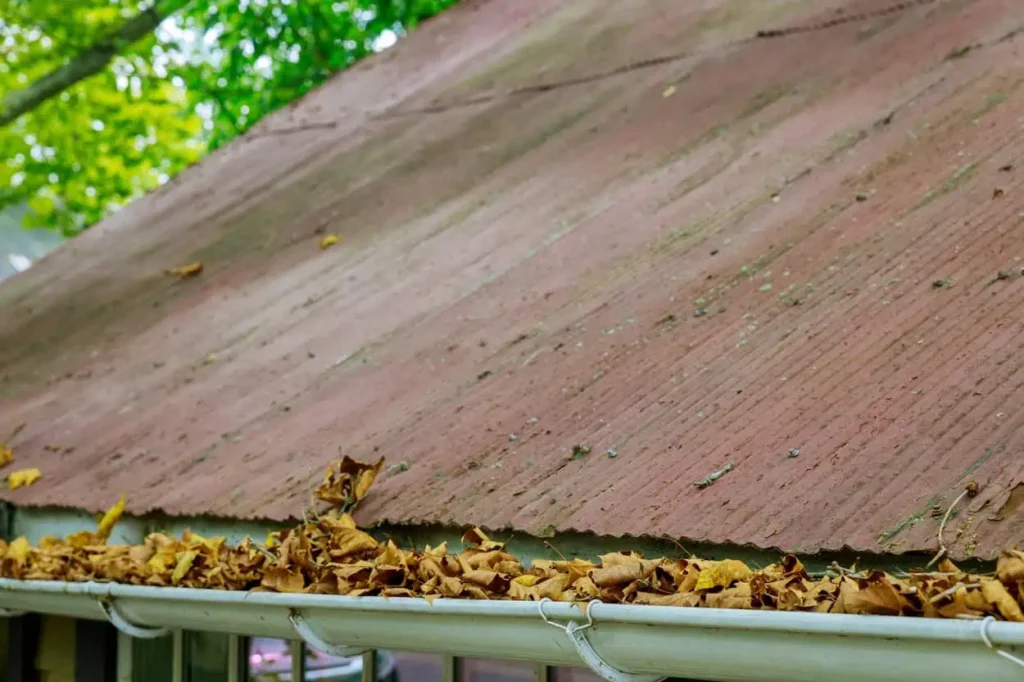
Blocked and overflowing gutters are a genuine source of building damp. When leaves, vegetation or other debris prevent rainwater from flowing towards the outlet and downpipe, water can overflow against walls, fascias, soffits and roof edges.
Why the Damp Patch May Not Be Where the Leak Starts
One of the easiest mistakes is assuming that the source must sit directly above the damp mark.
Water can travel through or along parts of the roof and building fabric before it finally becomes visible indoors. A ceiling or wall stain can therefore appear some distance away from the actual point where rainwater entered.
Before deciding what needs fixing, note:
- where the damp first appears;
- whether it happens during every rainfall or mainly in heavy or wind-driven rain;
- whether nearby gutters overflow at the same time;
- whether the staining sits close to an eaves line, chimney or other roof junction;
- whether moisture continues appearing after the rain has stopped.
These clues are more useful than the position of the ceiling mark alone.
When the Leak May Actually Be a Roof-Drainage Problem
A gutter problem is not always simply a visible pile of leaves.
Blocked Gutter, Outlet or Downpipe
Leaves, vegetation and other debris can stop water moving freely towards the outlet. If the flow is restricted, the gutter can fill and overflow instead of carrying water safely into the downpipe.
A gutter can also appear reasonably clear along its visible length while the restriction sits around the outlet or further along the rainwater path.
This is the type of problem where clearance may remove the underlying cause rather than merely treating the symptoms.
The Gutter Is Clear but Still Overflows
Repeated overflow does not automatically mean the gutter needs cleaning again.
Gutters should fall correctly towards their outlets. Sagging or poor alignment can allow water to pond, while a system that is too small for the volume of runoff may overflow during particularly heavy rainfall even without an obvious blockage.
Those are repair, adjustment or drainage-capacity problems rather than cleaning problems.
Roof moss is also relevant mainly where loose material interferes with gutters, outlets or other drainage points. Moss on the tiles themselves is not automatically evidence of a leak, and aggressive cleaning methods can damage some roof coverings.
When Gutter Cleaning Will Not Fix the Leak
Gutter cleaning only helps when debris or blockage is genuinely contributing to the water problem.
It will not repair:
- slipped, cracked or missing tiles or slates;
- failed flashing around chimneys, walls, vents or other penetrations;
- defective roof membranes or other roofing layers;
- split, detached or badly sagging guttering;
- incorrect gutter alignment or fall;
- a rainwater system that cannot handle the required flow;
- structural roof defects.
A clean but damaged gutter still needs repair, just as a clear gutter will not solve failed flashing or a broken tile.
If the drainage route has been cleared and the same water ingress continues, the cause needs reassessing rather than repeatedly treating it as a blockage.
What You Can Check Safely From the Ground or Inside
You can gather useful diagnostic information without walking on the roof.
From inside, record where the damp first appears and how it changes during rainfall. If there is a safely accessible loft, visible dampness or water tracking may provide another clue, but do not cross unsafe areas or touch electrical equipment to follow the stain.
From ground level or a safe internal viewpoint, look for:
- gutters overflowing while it rains;
- water running down walls below gutters or downpipes;
- visible sagging, separation or displacement in guttering;
- an outlet that appears unable to drain a filling gutter;
- obvious missing or displaced roof coverings;
- whether the problem appears only in particularly heavy rain.
Watching the rainwater system while it is actually raining can be particularly informative because overflow and drainage faults may not be obvious when everything is dry. Check whether water is travelling towards the outlet properly, whether it is ponding in sections of guttering and whether the downpipe appears to be carrying the expected flow.
Do not turn inspection into unsafe roof access. If the source cannot be established safely from the ground, inside the property or another suitable position, use an appropriately equipped professional.
How to Fix a Leaking Roof When Blocked Gutters Are the Cause
If the leak is being caused or worsened by debris preventing rainwater from flowing through the gutters correctly, the first step is to restore that drainage route.
Removing leaves, moss and other accumulated debris allows rainwater to move towards the outlet rather than filling the gutter and overflowing against the building.
However, cleaning is only the correct fix when blockage is actually the problem. Sagging or damaged guttering needs repair, while slipped tiles, failed flashing, membranes and other roofing defects need to be dealt with by a roofer.
Cardiff Window Cleaner Ltd has provided exterior cleaning since 2015, with more than 70 years of combined team experience across services including gutter cleaning, roof cleaning, pressure washing and specialist soft washing. Our approach is to consider the condition and likely cause of the problem rather than assuming every sign of water ingress needs the same treatment.
Get in touch today if you think blocked or overflowing gutters may be contributing to the problem.

How to Fix a Leaking Roof FAQs
Can blocked gutters cause a roof leak?
Blocked gutters can cause water to overflow against roof edges, fascias, soffits and external walls instead of draining safely away. In some cases, this can create damp or water ingress that appears to be a problem with the roof itself.
Why does my roof only leak during heavy rain?
A problem that appears mainly during heavy rain can point to several causes. A gutter or downpipe may be partially restricted, the gutter may be poorly aligned, or the rainwater system may struggle to handle the volume of water. Wind-driven rain can also expose weaknesses in roof coverings, flashing and other junctions.
The timing of the leak is therefore useful diagnostic information, but it does not identify the cause on its own.
Will cleaning my gutters fix a leaking roof?
Only if blocked gutters or outlets are contributing to the problem.
Gutter cleaning will not repair damaged tiles, failed flashing, membranes, split guttering or structural roofing defects. If the gutters are clear and water is still entering, the source needs further investigation.
Can I fix a leaking roof myself?
You can safely limit internal damage and inspect many visible signs from the ground or inside the property, but climbing onto a roof to diagnose or repair a leak carries significant risk.
If the problem involves tiles, flashing, membranes or another part of the roof covering, use an appropriate roofing professional. If the evidence points towards blocked or overflowing gutters, professional gutter cleaning may be the relevant next step.